The Tool I Love, and the One Thing That Drives Me Mad About It
I've used a lot of psychometric tools over the years. Some have been useful, and others have gathered dust. Insights Discovery is different.
I've learned more about myself from doing it than almost anything else in my leadership journey. I've watched it change how teams communicate, how leaders stop taking feedback personally, how people who've worked together for years suddenly understand each other in a completely new way.
If you haven't done it, it’s worth looking in to.
But there's one thing that drives me mad. The labels….
The problem with the labels
Fiery Red. Sunshine Yellow. Earth Green. Cool Blue.
Each colour comes with a set of descriptors:
Fiery Red - competitive, demanding, determined, strong-willed, purposeful
Sunshine Yellow - sociable, dynamic, demonstrative, enthusiastic, persuasive
Earth Green - caring, encouraging, sharing, patient, relaxed
Cool Blue - cautious, precise, deliberate, questioning, formal
The descriptions aren't wrong. The problem is what they do to everyone else in the room.
The moment you tell a Red leader that Green people are "caring and patient", consciously or unconsciously, two things happen.
First, they file it away as not them.
Second (and this is the bit that does the real damage) they conclude that being caring and patient is somehow incompatible with being results-driven. That you can't be both. That warmth and drive live in different people, not in the same one.
And we bring all of our existing assumptions to that moment. The boss who was tough but fair. The colleague who was brilliant but cold. The manager who was lovely but never got promoted. We've been building a picture of what different types of leaders look like our whole careers, and Insights, if it's not handled carefully, just gives those assumptions a colour-coded home.
If you're Sunshine Yellow, you can't be Cool Blue precise. If you're Earth Green, you can't be Fiery Red decisive.
Except you can. You just might have to work at it.
And in hospitality and retail, leaders who've decided what they are and aren't capable of are working with one hand tied behind their back.
Here’s mine
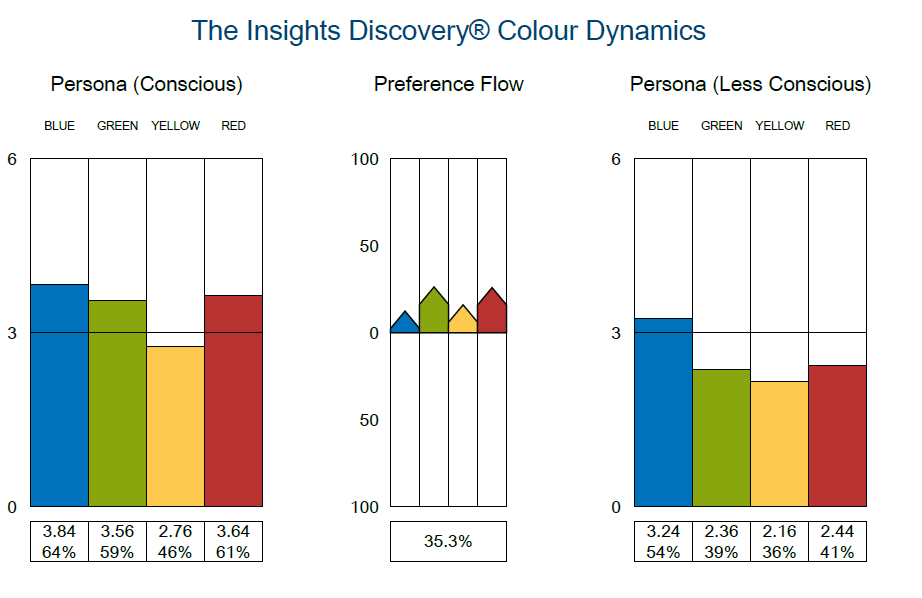
Four colours, that are relatively balanced - and no single one dominates.
I score highest on Blue and Red - precision and drive. But my Green and Yellow are close behind.
This doesn't tell me I'm a Blue-Red leader. It tells me I have access to all four. And depending on the situation - perhaps a difficult conversation, a strategic planning session, a team that needs rallying - the leader I need to be in that moment might look very different to my default.
What's also interesting is the right-hand chart - how I show up under pressure. My Green drops. My Blue drops too. Under stress I default more heavily to Red - decisive, direct, focused on results.
That's useful to know. Because under pressure, if I'm not paying attention, I'm leading almost entirely from Red - when the situation might be asking for something else entirely.
What Insights is actually trying to tell you
It's not trying to put you in a box. It's trying to show you your starting point. The whole point is understanding your default, and not being defined by it.
A Red leader who can slow down and listen when a team member needs to feel heard (even if it doesn't come naturally) is more effective than one who leads every conversation the same way. A Blue leader who can step into Yellow energy when the room needs enthusiasm is leading from choice, not habit.
The either/or thinking that the labels can create is the opposite of what good leadership looks like. The most effective leaders aren't one thing, they're the full range and they've done the work to know which part of themselves a situation is asking for.
What to do with this
If you've done Insights Discovery, I invite you to go back and look at your profile, specifically the difference between your conscious and less conscious positions. That gap is where the interesting work is.
If you manage a team, resist the urge to use the colours as shorthand. "She's very Green" or "he's a classic Red" may sound helpful but it lets people off the hook, or puts them in a box, for developing the full range.
And if you haven't done it yet and are interested, find a practitioner and do it. Just go in knowing that the colours are a starting point, not a destination.
I'm Sarah Clark, an executive and leadership coach for hospitality and retail leaders. If this resonated with you, I'd love to have a conversation. Book a free consultation at nineyardscoaching.co.uk